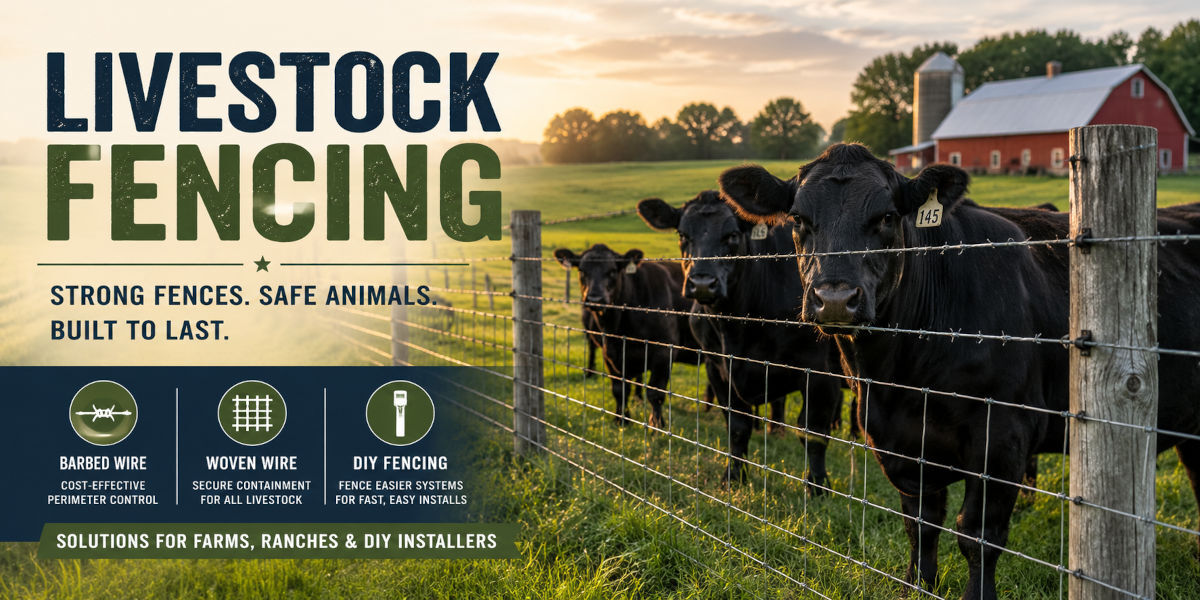
Livestock Fencing

Livestock Fencing: Strong Fences. Safe Animals. Built to Last

Livestock Fencing for Farms, Ranches & DIY Installations

Build a reliable enclosure with our selection of livestock fencing products designed for farms, ranches, pastures, and rural properties. This category includes traditional livestock fence options like barbed wire and woven wire, along with innovative DIY livestock fencing solutions from Fence Easier for faster, simpler installation.

Whether you are containing cattle, goats, horses, sheep, or other animals, choosing the right fence helps improve safety, control access, and protect your property. Barbed wire is a cost-effective choice for large pasture perimeters, woven wire offers added containment for smaller animals, and Fence Easier products are ideal for DIY installers who want a strong fence without digging traditional post holes.

  • Multiple fencing options — Choose from barbed wire, woven wire, and DIY livestock fencing systems.
  • Built for rural use — Designed for pastures, farms, ranches, and large property boundaries.
  • DIY-friendly installation — Fence Easier products help simplify fence installation and future post replacement.
  • Flexible animal containment — Select the right livestock fence for cattle, goats, sheep, horses, and mixed-use properties.
  • Practical, long-term value — Durable materials help reduce maintenance and improve fence performance over time.

Choosing the Right Livestock Fence for Your Property

The best livestock fencing depends on the animals you are containing, the size of the pasture, the terrain, and whether the fence is being used as a permanent perimeter fence, cross fence, or temporary enclosure. Cattle, goats, sheep, horses, and mixed livestock all place different demands on a fence, so choosing the right material up front can reduce repairs, improve animal safety, and make your installation more efficient.

For large pasture boundaries, barbed wire livestock fence is a traditional and cost-effective option commonly used for cattle and other large animals. Woven wire fencing is a stronger physical barrier for smaller animals, mixed livestock, and areas where tighter containment is needed. For property owners who want a faster, more approachable installation, DIY livestock fencing systems from Fence Easier offer a practical alternative to traditional post-hole digging and bracing methods.

Common Livestock Fence Options

  • Barbed Wire Fencing — A practical choice for cattle, pasture perimeters, and long rural fence lines where cost-effective boundary control is the priority.
  • Woven Wire Fencing — A more secure physical barrier for goats, sheep, calves, dogs, and mixed livestock because the wire grid helps prevent animals from squeezing through.
  • DIY Livestock Fencing Systems — Fence Easier products are designed for simpler installation using T-post based bracing and support components, making them helpful for DIY farm and ranch projects.
  • Combination Fences — Many livestock fences use woven wire with a top strand of barbed wire or electric wire for added height, visibility, or pressure control.

Livestock Fence Buying Guide

Before ordering livestock fence materials, consider the type of animals you are containing and how they behave around fencing. Cattle usually need strong perimeter control and may push or lean on fencing. Goats and sheep require tighter spacing because they are more likely to test gaps, squeeze through openings, or challenge weak spots. Horses benefit from highly visible fencing and should be fenced with animal safety in mind.

  • For cattle — Barbed wire, woven wire, or high-tensile style fencing can work depending on stocking density, pressure, and pasture layout.
  • For goats and sheep — Woven wire is usually the better choice because smaller animals need tighter containment than standard barbed wire provides.
  • For horses — Visibility and safety are especially important; avoid fence setups that are difficult for horses to see or that increase entanglement risk.
  • For mixed livestock — Choose the fence based on the hardest animal to contain, not the easiest.
  • For DIY projects — Fence Easier systems can simplify bracing and post installation, especially for property owners who want a more manageable installation process.

Barbed Wire vs. Woven Wire vs. DIY Livestock Fencing

Fence Type Best For Key Advantages Considerations
Barbed Wire Cattle, pasture perimeters, large rural properties Cost-effective, widely used, good for long fence runs Not ideal for goats, sheep, or animals that require tighter containment
Woven Wire Goats, sheep, calves, mixed livestock, tighter containment areas Strong physical barrier, smaller openings, versatile farm use Higher material cost than basic barbed wire and requires proper stretching
DIY Livestock Fencing DIY farm fencing, rural property owners, simpler installations Designed to reduce installation complexity and make fencing more approachable Best choice depends on your layout, soil, gate locations, and livestock pressure

Planning a Better Livestock Fence Installation

A strong livestock fence starts with a good layout. Plan your corners, gates, end posts, and brace points before installing line posts or stretching wire. Corners and gate openings carry much of the fence tension, so these areas should be reinforced properly for long-term performance.

For long fence runs, uneven ground, or pasture divisions, it is also important to think about maintenance access. A well-planned livestock fence should help you move animals, rotate pasture areas, access gates easily, and repair sections without having to rebuild the entire line.

Frequently Asked Questions About Livestock Fencing

What is the best livestock fencing for cattle?
Barbed wire, woven wire, and high-tensile style fence systems can all be used for cattle depending on the pasture layout, stocking density, and fence pressure. Barbed wire is common for large cattle pastures, while woven wire provides a stronger physical barrier where added containment is needed.
Is woven wire better than barbed wire for goats and sheep?
Yes, woven wire is usually the better livestock fence choice for goats and sheep because the grid pattern provides tighter containment. Standard barbed wire fences are generally better suited for larger livestock like cattle and are not as effective for smaller animals that can squeeze through wider openings.
Can I install livestock fencing myself?
Many livestock fencing projects can be installed by property owners with the right materials, layout, and tools. DIY livestock fencing systems from Fence Easier are designed to make fence installation more approachable by simplifying post support and bracing methods.
What type of livestock fence should I use for mixed animals?
For mixed livestock, choose the fence based on the animal that is most difficult to contain. A fence that works for cattle may not be secure enough for goats, sheep, calves, or dogs, so woven wire or a combination fence is often a better choice for mixed-use properties.
Do I need barbed wire on top of woven wire fencing?
A top strand of barbed wire is commonly added to woven wire fences when extra height, deterrence, or animal pressure control is needed. Whether it is necessary depends on the livestock, fence height, and location of the fence line.
What should I consider before buying livestock fence materials?
Consider the livestock species, fence height, wire spacing, total fence length, post type, corners, gates, terrain, and whether the fence is permanent or temporary. Good planning helps reduce material waste and improves long-term fence performance.

Build a Stronger Livestock Fence with the Right Materials

Whether you are fencing a backyard pasture, a small hobby farm, or a larger ranch property, the right materials make the project easier and more dependable. Shop our selection of barbed wire, woven wire, and DIY livestock fencing products to find the best livestock fence for your animals, property, and installation style.