
Chain Link Fence Post and Framework Guide
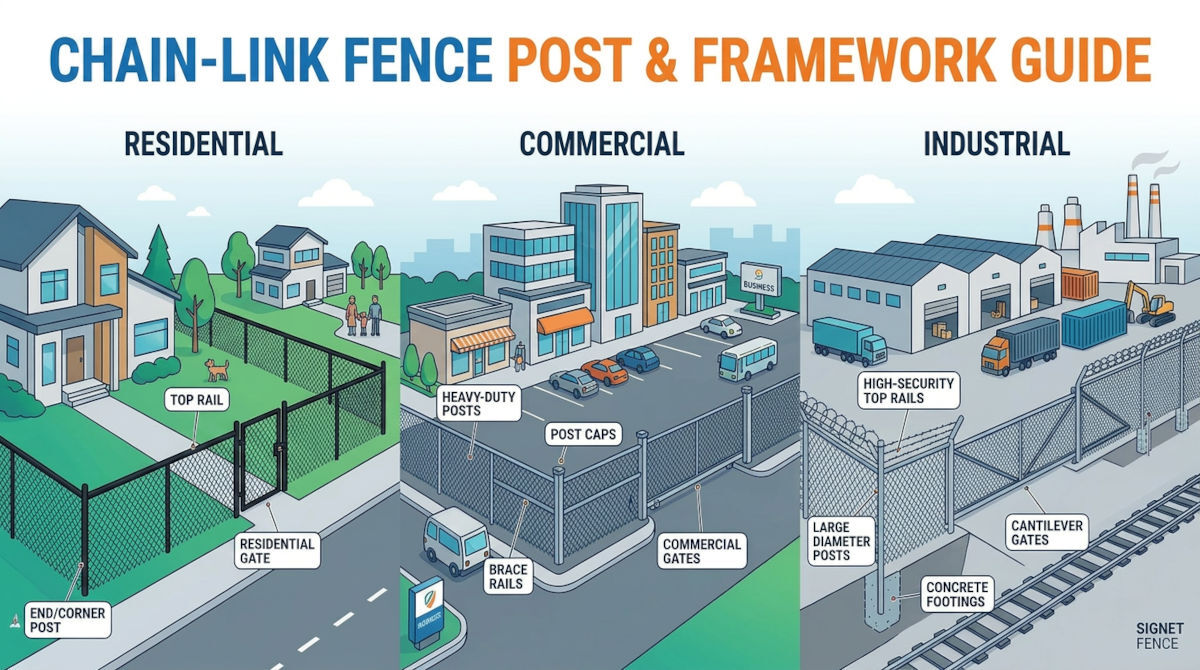
Chain Link Fence Posts and Framework Guide: Post Sizes, Pipe Types, Rails & Framework Explained
The posts and framework are the structural backbone of a chain link fence. While the fabric creates the barrier, the posts and rails provide the strength that keeps the fence straight, tight, and standing for years. Choosing the correct post sizes, pipe wall thickness, spacing, and framework materials is one of the most important parts of building a strong chain link fence.
This guide explains the different types of chain link fence posts, pipe sizes, wall thickness options, post spacing, rails, and how to choose the right framework for residential, commercial, and industrial chain link fence projects.
Quick Chain Link Framework Recommendations
Use this section as a quick starting point when choosing chain link fence posts, line posts, and top rail sizes for common applications.
- Light Residential Fence: 2" terminal posts (.065 wall), 1-5/8" line posts (.055 wall), 1-3/8" top rail (.055 wall)
- Residential Fence: 2-1/2" terminal posts (.065 wall), 2" line posts (.065 wall), 1-3/8" top rail (.065 wall)
- Heavy Residential / Light Commercial: 2-1/2" terminal posts (SF20), 2" line posts (.065 wall or SF20), 1-5/8" top rail (.065 wall)
- Commercial Fence: 3" terminal posts(SF40), 2-1/2" line posts (SF20 or SF40), 1-5/8" Top Rail (SF20)
- Industrial Fence / Heavy Gates: Post sizes vary widely by function. Schedule 40 posts & framework.
- Recommended Post Spacing: 8' for strength, up to 10' for lighter residential fences
What Is Chain Link Fence Framework?
Chain link fence framework refers to all of the structural steel components that support the fence fabric. This includes terminal posts, line posts, top rail, bottom rail or tension wire, and the fittings that connect everything together (fittings are covered in a different guide).
A chain link fence is essentially a stretched piece of steel fabric supported by a steel pipe frame. If the framework is too light, the fence will sag, lean, or fail over time. A strong framework with properly sized posts will keep a fence tight and straight for many years.
Types of Chain Link Fence Posts
Terminal Posts
Terminal posts are the main structural posts of a chain link fence. They are installed at the ends of fence runs, at corners, and on both sides of gate openings. Terminal posts must be larger and stronger than line posts because they hold the tension of the stretched chain link fabric.
- End posts
- Corner posts
- Gate posts
Line Posts
Line posts are installed between terminal posts and support the top rail and chain link fabric. Line posts are typically smaller than terminal posts and are spaced evenly along the fence line.
Common Chain Link Fence Post and Rail Sizes
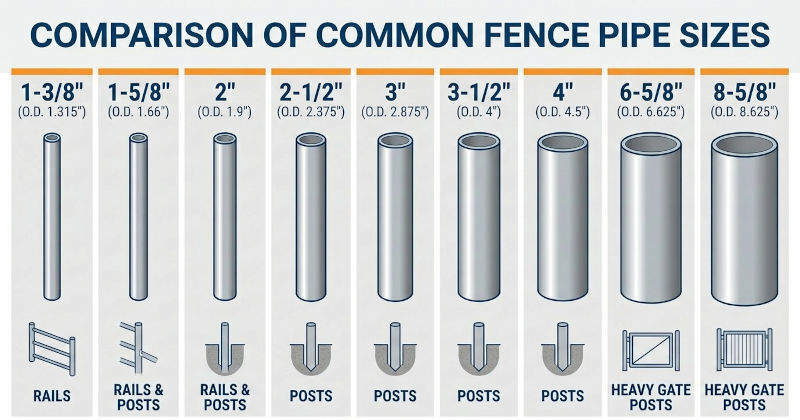
| Fence Type | Terminal Posts | Line Posts | Top Rail |
| Light Residential | 2" | 1-5/8" | 1-3/8" |
| Residential | 2-1/2" | 2" | 1-3/8" |
| Heavy Residential / Light Commercial | 2-1/2" heavier wall | 2" heavier wall | 1-5/8" |
| Commercial | 3" | 2-1/2" | 1-5/8" or 2" |
| Industrial | 3" or greater | 2-1/2" or greater | 2" |
Understanding Chain Link Fence Pipe Wall Thickness
Chain link fence pipe is not just defined by diameter. The wall thickness of the pipe is extremely important because it determines how strong the post is. Two posts may both be 2" diameter, but the one with a thicker wall will usually be stronger & more durable.
Common Chain Link Pipe Wall Types
Galvanized
- .055 Wall: Light residential fence
- .065 Wall: Standard residential fence
- SF20: Heavy residential / light commercial
- SF40: Commercial / industrial
- Schedule 40: Industrial / heavy gate posts
Color Coated
Chain Link Fence Pipe Size, Wall Thickness & Weight Chart
This quick comparison chart shows common chain link fence pipe outside diameters, wall thicknesses, approximate pounds per foot, and gauge designations for .055 wall, .065 wall, SF20, SF40, and Schedule 40 pipe.
| Pipe Size (Actual OD) | .055 Wall 17 ga / lbs per ft |
.065 Wall 16 ga / lbs per ft |
SF20 / SPS20 wall / gauge / lbs per ft |
SF40 / SPS40 wall / gauge / lbs per ft |
Schedule 40 wall / gauge / lbs per ft |
|---|---|---|---|---|---|
| 1-3/8" (1.315") | 0.055" / 17 ga / 0.740 | 0.065" / 16 ga / 0.868 | 0.080" / 14 ga / 1.055 | 0.080" / 14 ga / 1.055 | 0.133" / 10 ga / 1.679 |
| 1-5/8" (1.660") | 0.055" / 17 ga / 0.943 | 0.065" / 16 ga / 1.107 | 0.085" / 13 ga / 1.430 | 0.111" / 11 ga / 1.836 | 0.140" / 9 ga / 2.273 |
| 2" (1.900") | 0.055" / 17 ga / 1.084 | 0.065" / 16 ga / 1.274 | 0.090" / 13 ga / 1.740 | 0.120" / 11 ga / 2.281 | 0.145" / 9 ga / 2.718 |
| 2-1/2" (2.375") | 0.055" / 17 ga / 1.363 | 0.065" / 16 ga / 1.604 | 0.095" / 13 ga / 2.313 | 0.130" / 10 ga / 3.117 | 0.154" / 8 ga / 3.653 |
| 3" (2.875") | — | — | 0.110" / 11 ga / 3.248 | 0.160" / 8 ga / 4.639 | 0.203" / 6 ga / 5.793 |
| 3-1/2" (3.500") | — | — | — | 0.160" / 8 ga / 5.707 | 0.216" / 5 ga / 7.576 |
| 4" (4.000") | — | — | — | 0.160" / 8 ga / 6.562 | 0.226" / 4 ga / 9.109 |
| 6-5/8" (6.625") | — | — | — | — | 0.280" / 1 ga / 18.97 |
| 8-5/8" (8.625") | — | — | — | — | 0.322" / 0 ga / 28.56 |
Notes: Values shown are based on SPS round pipe weights, wall, and gauge chart.
As wall thickness increases, the strength and weight of the pipe typically increases as well. Heavier posts are more resistant to bending, wind loads, and gate stress.
Chain Link Fence Post Spacing
Post spacing affects both the strength and cost of a chain link fence. Closer post spacing makes the fence stronger and reduces sagging. Wider spacing reduces material cost but may allow more movement in the fence.
- 8' spacing: Recommended for stronger fences and long-term durability
- 10' spacing: Common for residential fences with top rail
- Over 10': Typically only used for temporary fencing
For most permanent fences, we recommend spacing posts around 8 feet apart when possible for better strength and reduced sagging over time.
Top Rail, Bottom Rail, and Tension Wire
The top rail runs horizontally along the top of the fence and connects all of the line posts together. This greatly increases the strength of the fence and helps keep the fabric tight.
- Top Rail: Standard on most residential and commercial fences. Keeps the fabric from sagging between line posts.
- Bottom Rail: Used on commercial and high-security fences for additional strength. Used on residential fences to prevent pets or wildlife from digging under the fence.
- Tension Wire: Lower-cost alternative to bottom rail. More difficult to climb than bottom rail.
Common Chain Link Framework Mistakes
- Using posts that are too small for the fence height
- Spacing posts too far apart
- Using thin-walled posts for heavy gates
- Not using top rail
- Choosing framework based on price only
Complete Your Chain Link Fence System
To build a complete chain link fence, you will also need chain link fabric and fittings. See our guides below:
Frequently Asked Questions
Which chain link posts do I need for a fence for my yard?
Posts can vary based on your unique situation. How tall of a fence do you need? Do you have large dogs? Do you plan to put privacy slats or screen on the fence, thereby increaing the wind load? All of these factors can affect the diameter and gauge of the chain link posts and framework that you choose. In general, however, a good general purpose 3' - 5' backyard chain link fence that balances costs with durability can use 1-3/8" top rail, 1-5/8" line posts, 2" terminal posts, and 2" or 2-1/2" gate posts (depending on gate size). All .065 framework.
How far apart should chain link fence posts be spaced?
8 feet is recommended for strength, but residential fences may use up to 10 foot spacing.
What is SF20 fence pipe?
SF20 is a heavier wall chain link fence pipe used for heavy residential and light commercial fences.
When should I use Schedule 40 fence posts?
Schedule 40 posts are typically used for industrial fences, commercial projects, and heavy gate posts. They are also commonly used for taller fences that have privacy screening or privacy slats, and as steel posts used for wood privacy fencing.